When the government announced that income up to ₹12 lakh is tax-free under the New Tax Regime, most salaried employees stopped reading right there.
That's a costly mistake.
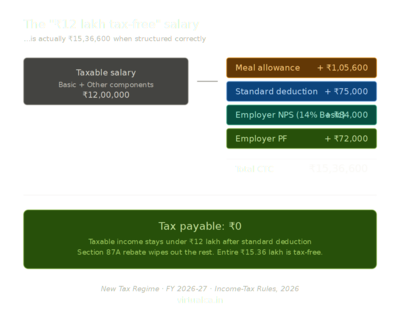
The ₹12 lakh figure is just the taxable income threshold. Your actual CTC can be structured much higher, and you'll still pay zero tax. With the right components in your salary structure, a CTC of ₹15,36,600 can be entirely tax-free, legally.
Here's how the math works.
The Three Components Nobody Talks About
1. Meal Allowance — ₹1,05,600 exempt
Under the Income-Tax Rules 2026, meal vouchers (Sodexo, Pluxee, Zaggle, Zeta) are tax-exempt up to ₹200 per meal, for up to 2 meals a day.
22 working days × 2 meals × 12 months × ₹200 = ₹1,05,600 per year, tax-free
The earlier ₹50 per meal cap has been raised to ₹200 from FY 2026-27, and this exemption now applies under the New Tax Regime too. This is a recent change most salary structures haven't caught up with.
2. Standard Deduction — ₹75,000
Available to every salaried employee under the New Regime, with no conditions. Automatic. Use it.
3. Employer's Contribution to NPS — Up to 14% of Basic Salary
If your employer contributes to the National Pension Scheme on your behalf, up to 14% of your basic salary is fully exempt under Section 80CCD(2). This exemption is available under the New Regime (it's one of the few that survived).
For a Basic of ₹6,00,000 → that's ₹84,000 exempt per year.
4. Employer's PF Contribution
Employer's PF contribution is exempt up to ₹7.5 lakh aggregate (along with NPS and superannuation). For most CTCs, this is fully tax-free.
The Full Picture
| Particulars | Without NPS Cap | With NPS Cap |
|---|---|---|
| Basic Salary | 6,00,000 | 6,00,000 |
| Other Components | 6,00,000 | 6,00,000 |
| Meal Allowance | 1,05,600 | 1,05,600 |
| Sub-total | 13,05,600 | 13,05,600 |
| Less: Standard Deduction | (75,000) | (75,000) |
| Taxable Salary | 12,30,600 | 12,30,600 |
| Add: Employer NPS Contribution | 84,000 | 84,000 |
| Add: Employer PF Contribution | 72,000 | 21,600 |
| Total CTC | ₹15,36,600 | ₹14,86,200 |
Both scenarios bring taxable income comfortably below the ₹12 lakh threshold (after using the ₹60,000 rebate under Section 87A), making the entire CTC effectively tax-free.
What Most People Get Wrong
The "12 lakh tax-free" headline made everyone forget that salary structuring still matters. The New Regime didn't kill tax planning — it just changed the tools.
If your HR is still issuing salary structures designed for the old regime (HRA-heavy, LTA, 80C-focused), you're leaving money on the table. The new playbook is:
- Maximise meal vouchers (₹1.05 lakh)
- Push employer NPS contribution to 14% of Basic
- Optimise Basic Salary so PF and NPS exemptions scale up
- Skip components that don't work in the new regime (HRA exemption, LTA, Section 80C investments)
Want This Done For Your Salary?
If you're a salaried professional, ask your HR if your CTC can be restructured along these lines — most companies will accommodate it because their cost stays the same.
If you're an employer or founder running payroll for your team, this is exactly the kind of structuring that lets you attract talent without inflating your wage bill.
Need help restructuring your CTC or your team's payroll? Talk to us at VirtualCA.in — we'll build a salary structure that works for the new regime, not the old one.
Disclaimer: This article reflects provisions under the New Tax Regime as per Income-Tax Rules 2026, applicable from FY 2026-27. Actual exemptions depend on individual employer policies and CTC structures. Consult a Chartered Accountant for advice specific to your case.
Comments